
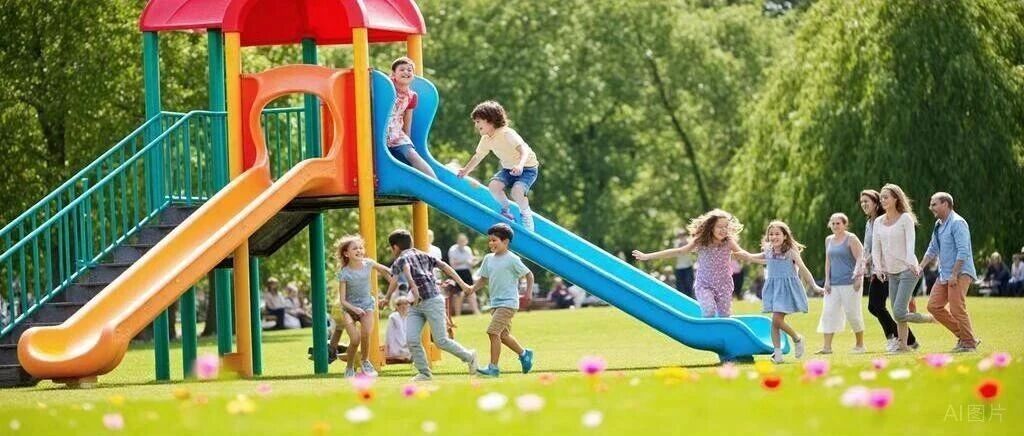
The first time I heard the term "non-powered playground equipment," I thought it meant a budget playground — no electricity, so it saves money, that's it.
After taking my son to a few, I finally understood why more and more parents — including some quite particular ones — swear by these spaces.
What does 'non-powered' mean?
Non-powered playground equipment doesn't require electricity. No carousels, no electric trains, no coin-operated rides, no button-controlled digital games.
What it does have: climbing frames, rope nets, slides, sandboxes, water play areas, rolling drums, balance beams, swings, wooden structures...
All the most primal forms of play. Children use their own bodies to overcome obstacles — no assistance.
Which is exactly why it's called "non-powered": the equipment has no power of its own. The child's body is the power.
Why kids get more engaged
I've watched this many times, and I think I've figured out the reason.
With powered equipment, the logic is: you sit in it, and the machine moves you. On a carousel, an electric train, or bumper cars, the child is passive — carried along by the machine, receiving an experience provided externally.
With non-powered equipment, the logic is: you decide how to play, and the equipment goes along with you. That rope net — you can climb it, swing on it, sit on it, or find a friend to shake it with. No fixed instructions. The child decides how to play.
This openness is what truly engages children. Haven't you noticed? Sometimes a child gets a high-end toy and loses interest in two minutes — but can spend half an hour with a cardboard box. A cardboard box is non-powered. What it can do depends entirely on the child's imagination.
Real benefits, in plain terms
First, sensory integration. Climbing, balancing, jumping, crawling — these movements engage tactile, vestibular, and proprioceptive systems. They provide comprehensive stimulation that indoor button-press games simply can't match. The equipment used by professional sensory integration therapists? Basically non-powered devices.
Second, social interaction happens naturally. Powered equipment typically involves queuing, riding, finishing, and getting off — minimal interaction between children. But sandboxes, water tables, and rope nets naturally draw kids together to play, negotiate, cooperate, argue, and resolve — real social scenarios.
Third, parents can relax. Non-powered playgrounds usually have fences or clear boundaries. As long as you're at the exit, you can basically let them explore without hovering. It's liberating for both parent and child.