
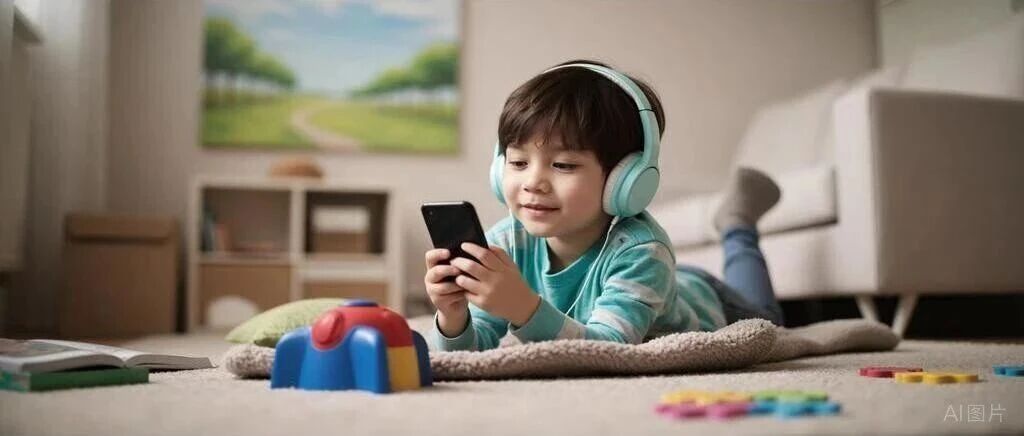
On the phone question, our family has broken down in negotiations at least ten times.
The most extreme case: when Little Tiger was two and a half, he was hugging my phone, watching those toy-unboxing videos. I said time was up. He dropped to the floor and rolled, face pressed against the tiles, crying. I stood there not knowing what to say, and we froze in a stalemate where nobody won.
Later I spent a long time researching this and testing several approaches, and slowly found some patterns.
First, the difference in how much screens hurt eyes
Many parents have an intuition: a phone must hurt the eyes more than a TV, because the phone is small and you hold it close.
That intuition is right, but the reason behind it is more specific than you’d think.
The most critical factors for eyesight are viewing distance and continuous screen time.
A phone screen is small, so a child naturally leans in — often with eyes only twenty to thirty centimeters from the screen. At that distance the ciliary muscle stays highly tensed, and myopia risk shoots up.
A TV screen is large and usually sits two meters away, so when a child watches, the distance is much greater and the ciliary muscle load is far smaller.
A tablet sits in between — better than a phone, worse than a TV.
So if a child really must watch video, the most eye-friendly way is: cast to a large TV, keep about three meters of distance, and have him sit up to watch — not lying down or sprawled on his stomach. That single change shrinks the impact on eyesight a lot.
What’s wrong with the “just five minutes” rule
Many parents manage kids with “you can only watch five minutes,” then take the phone away when the time is up.
This method has a fundamental execution problem: five minutes is too short for a child. It’s so short that he hasn’t even gotten into the content — he’s still in the state of just being drawn in, and then it’s suddenly taken away. Of course he breaks down.
The child cries, the adult gives in, five more minutes, then another five — and in the end no rule is left at all.
A more effective approach is to end at the point where the child has “finished a complete piece of content.”
For example, when one episode of an animation ends, stopping there is natural, not a forced interruption. The child gets a complete experience, and psychologically it’s much easier to accept.
Then make clear when he can watch next, so he has an expectation. “You’ve had today’s, tomorrow after dinner you can watch one more episode” works far better than “No more watching!”
Which approaches worked and which didn’t
Let me talk about what I actually tried.
Approach one: hide the phone. Didn’t work. He finds it, and finding it makes him even more excited — it becomes a game of keep-away.
Approach two: set an app time lock. This one works somewhat, but kids find loopholes — another device, or Grandpa’s phone. It treats the symptom, not the cause, but it can serve as a helper.
Approach three: give him a fixed “screen time” slot, treated as a regular part of the day rather than given randomly when he asks. This has worked best so far. He knows that today at 4 p.m. he gets twenty minutes, so he doesn’t come asking all day — because he “knows” it will happen.
Approach four: cast to the TV and watch together as a family. This was the most surprising success — because adults are there too, the child feels it’s a family activity, not something he sneaks off to enjoy, so resistance and meltdowns drop a lot. And the big screen is kinder to the eyes — two birds with one stone.
What should the rules actually be?
I don’t think there’s one universal answer, but a few principles apply across the board.
First, rules should be announced in advance, not changed on the spot. Snatching it away mid-watch, the child can’t accept that. Tell him beforehand, “today you can watch two episodes, and when they’re done, it’s off.” He knows what to expect during the process, and when the end arrives he may even say it himself.
Second, rules should be predictable, not vague. “Watch a bit less” gives a child no idea how to execute; “today you watch one episode” is clear.
Third, adults have to do it first. You tell the child “less phone time” while scrolling for two hours yourself — the child is watching you, not listening to you.
Fourth, give the child other outlets. When a child wants the phone, a lot of the time it’s not that he needs that specific video — he’s looking for something to do, something to focus on. If he has other fun things in hand, the phone’s pull naturally drops.
My relationship with Little Tiger on this is still bumpy from time to time, but much better than before. Now he’ll say “I’ve had enough for today” on his own and go find something else to do — that evolution took about a year.